
 5 years ago when I started Web Circle I did a bunch of research on which CMS to choose and decided on Joomla!.
For a year or so it was the CMS we used for pretty much every website and it was very sophisticated for what it could do at the time – particularly with the growing extensions directory. However as time went on and WordPress got better and better we gradually moved to using WordPress for most of our small business websites.
Since these days we focus predominantly on small business website design, WordPress has become the platform we use for the majority of our new sites (note we also still use Joomla!).
In 2006
In 2006 WordPress was seen mainly as a blogging tool and Joomla! was in my view the CMS with the most potential. I haven’t come across specific market share figures from the time but have a look at this Google Trends screenshot.
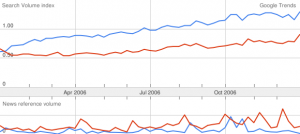
ABOVE: Screenshot showing 2006 Google searches – Joomla (blue) and WordPress (red)
There were some niggly things about each platform which people used to mention. The things about WordPress tended to be around it’s lack of flexibility in display, it’s focus mainly on blogging, limited menu capabilities etc. The Joomla issues were security and usability (particularly the way it separated menus and content items / articles).
So rewind to 2006, what did each platform need to do to win this race? There are a lot of complicating factors. One big one is WordPress managed to gain a huge foll0wing with it’s free hosted version WordPress.com – this no doubt propelled it’s uptake and spread the word particularly among DIY web builders (not so much developers).
But let’s just say the job of each system back then was pretty straight forward. Think of it like a business, you need to listen to your customers and give them what they want. So in other words, improve on the things that people don’t like about the system and make it so people do like it.
Both systems were free, both had a good market share and relatively equal potential to win this race.
Perhaps this is a simple view but let’s look at what happened.
The situation now
This chart shows Joomla! and WordPress searches over all years available.
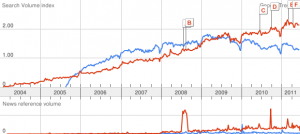
ABOVE: Screenshot showing 2006 Google searches – Joomla! (blue) and WordPress (red)
In terms of Market Share, in the 2008 Water and Stone Open Source CMS Report Joomla! downloads were about 25% of WordPress downloads. In the 2010 report they were11%. I’m guessing the 2011 report will show a similar trend.
Some reports show WordPress market share to be as high as 63%.
So what happened?
Let’s assume that both systems were actively going after this DIY or small business type market (it’s worth noting that Joomla! has a big uptake among Governments and Universities etc and we still use it a lot for more complicated sites). What has WordPress done since 2006 and what has Joomla! done?
First off WordPress has managed to shrug it’s blogging history by bringing out new and improved features that have made it into a great platform for non-blog type sites (growing extensions, better menu management etc). But it’s managed to do it while also winning the battle with Movable Type on the blog front – during a time where the popularity of blogging has exploded – further spreading the word to people who want a blog as part of their site or even to those who want other sites that aren’t blogs and grew to love the platform.
Joomla! on the other hand hasn’t really dealt with the issues that were common back in 2006. Note that Joomla! is an entirely community driven system which does make things challenging when competing in a space filled mostly with systems with commercial backing (like WordPress). However Joomla has improved a lot since 2006 with 2 major version releases and the uptake in some sectors like Government etc has been very good. But did they fix those niggly issues that existed back in 2006? Let’s break it down.
1. Security
The main problem with security in Joomla! is not that the system is less secure than other systems. The problem is that when new versions come out, it’s a pain in the backside to upgrade the system. First of all you don’t even really know that the system is out of date (how hard would it be to put a notification up the top like WordPress does) but secondly the process for patching Joomla! is one that a web developer has to do – and even a web developer will take a while to do it. WordPress on the other hand can all be done by the site owner with a couple of clicks.
So even with the latest version of Joomla! Small business owners who are using it find it hard to (a) know when it needs to be patched and (b) to do the patching.
And this is just with minor version releases – the major version releases are literally all over the place.
Easy solution – Here is a super easy solution that Joomla! could have implemented 5 years ago – Make sites check for the latest version and if they become out of date display a message up the top that says the site is at risk and the website owner needs to speak with their web developer to upgrade the site. This would have been a couple of lines of code. Magento does it (in fact they pop it up right in your face and force you to acknowledge it) – WordPress does it while at the same time offering a 1-click upgrade option.
Better solution – I don’t know how complicated doing the 1-click patching is, a lot of systems don’t work this way but WordPress seem to have managed to make it work. In my experience putting this back in control of the site owner is going to reduce the amount of out of date sites by a huge margin – especially combined with the messaging above which is exactly how WordPress manages to do it (I note the new Joomla! 1.7 this functionality is available).
And with Major version releases I don’t know where to start. Do we need them? Can we not just improve something incrementally. If we do need them then I would suggest not bringing out a major version release until you have a simple upgrade path that is part of the core (not relying on 3rd party extensions) and something that steps through the process and automates it (for example files and replaces references in templates etc). No doubt this isn’t easy but major upgrades are a real thorn in Joomla!’s side.
2. Ease of use
Ease of use is a very important factor in the small business community. I’ve heard a lot of Joomla! site owners say they were looking forward to Joomla! 1.6 because the old version was hard to use. I heard the same things about 1.5 but the truth is neither release was really any easier to use than the original Joomla 1.
One of the main issues I see with the usability of Joomla! is the weird way it separates menus and pages. Small business owners see websites as comprised of pages – they always have. Joomla sees articles and sees menus as ways to link to articles. So the intuitive process for adding a page to a website you would think would be to log into the CMS, click on add a page, add the page and click Save. This would create the page and add a link to the main menu. On top of this you would need to have the ability to exclude pages from menus.
One CMS I have seen do this very well is a system called SilverStripe. How WordPress manages menus now goes close enough to re-producing this. But even after 5 years in Joomla! to create a new page you need to create an ‘Article’ (note changing the older terminology from content item to article didn’t help – as I say small business owners see them as pages). Then after creating the Article you need to go to a totally different section, find the menu that the site uses (hopefully there aren’t too many as there often are) and then create a link through to the article. And still even finding out how to link through to an article is not easy! it’s as hard as it was when I tried to do it as a web developer in 2006 for the first time and couldn’t work it out.
There are still people in the Joomla! forum asking how they can create a page.
Easy Solution – This is something I thought of 5 years ago when I first started using Joomla! that they could have easily done at any stage. Have Joomla! by default set to ‘automated menu’ mode – or at least force people to choose when they set it up. In automated menu mode there would be a top menu in the site which automatically listed very page (or article, or content item if they want to call it that). Surely this wouldn’t be that hard – even thrown in an option in the pages to not publish them in the menu. This would not impact on their ability to service larger sites because it would be a setting that could easily be turned off.
Better solution – To me the architecture of Joomla! has always been a bit strange. To me a better approach would be for the site owner to create a ‘page’ and on this page they could have the option to have a few different ‘layouts’ (it would default to the default specified by the template). Then once the page is created they could click on the various regions provided (regions would be specified in the template like they currently are) and they could choose what goes in each region. For example click the main region and enter text / HTML with an editor or choose to have it as a list of articles (and provide the ability to create these articles on the fly). And then click on the right column and add some text / HTML or choose from some inbuilt display modules.
This would effectively make Joomla! a different system but to me this is an entirely more logical way to go and it would very much support simple small business sites but could also be scaled to bigger sites like the current system can.
What is the message
To me the message in this is really clear and it’s about listening to your customers. The issues that were holding Joomla! back in 2006 are holding them back now and meanwhile WordPress have stamped out their issues and excelled at exactly those things that were problems for Joomla!
Joomla! continued improving but they didn’t improve in the areas that their customers wanted. At least not their small business customers.
WordPress listened, they didn’t want to be known as a blogging platform only – they made it easy – and they won.
What does the future hold
I really believe both systems have the potential to be prominent in the small business space moving forward. WordPress is here to stay and whether it has beaten Joomla! in this market yet it is certainly well on the way. Is it possible for Joomla! to claw back into this space and reverse the trend. For one thing the challenge now is huge.
Not only do they have to improve the things that customers want improved but that along will not be enough. That alone won’t reverse the trend against WordPress they are going to have to also innovate and come up with ways of doing things that WordPress can’t. And that is not going to be easy.
About the author: Dan Norris

Dan Norris runs Australian web design firm, A Website Designer. Dan is passionate about helping small business owners succeed online using WordPress.